My Capita Selecta project at Twente, as a warm-up for VPR. It builds on a UT master thesis (Ruumpol, 2026) that put a small geometry head on top of a frozen DINOv2 backbone and trained it on MegaDepth without any pose labels.
Can VGGT's depth confidence tell DINOv2 which patches matter for a place, and does a geometry head learn better geometry from that cleaner input?
Short answer, after one long day on the cluster: VGGT does point at the right patches, but DINOv2 already knows them. And the head doesn’t learn real geometry from any input.
The starting point
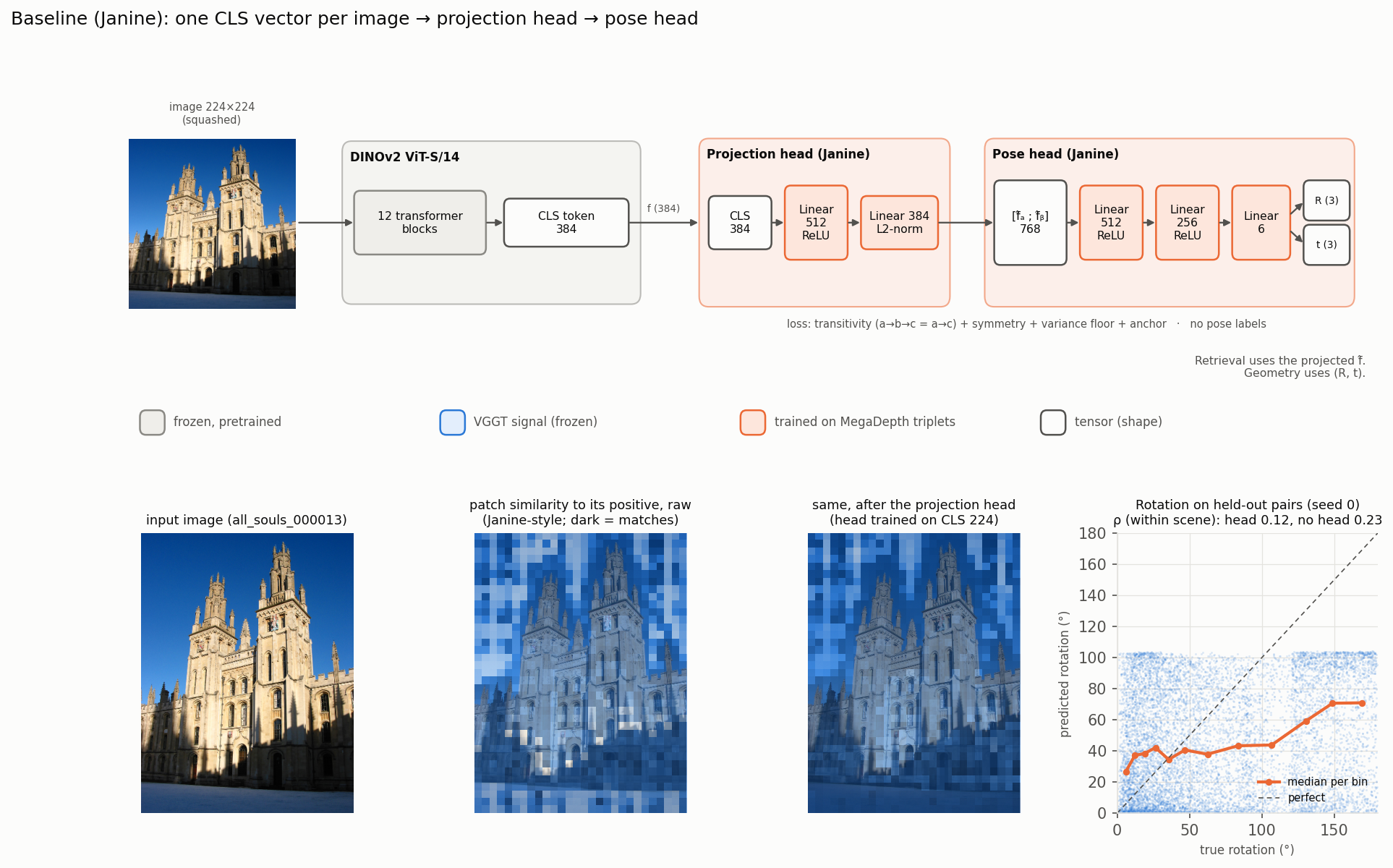
The reference pipeline encodes each image once into one global vector (the CLS token, 384-d) and trains two MLPs on top:
- Projection head , L2-normalised. Its output is the retrieval descriptor.
- Pose head (768) : a relative rotation (axis-angle) and translation between two cameras.
There are no pose labels. The only signal is transitivity on triplets :
plus a symmetry term (), a variance floor (std of predictions ) and an anchor/diversity term, because transitivity alone collapses to “no motion”.
My worry from the start: is "don't collapse" the same as "be correct"?
Transitivity has infinitely many solutions. Three of the four loss terms only push away from degenerate solutions. None of them says which rotation is right. That’s exactly what we ended up measuring below.
The idea
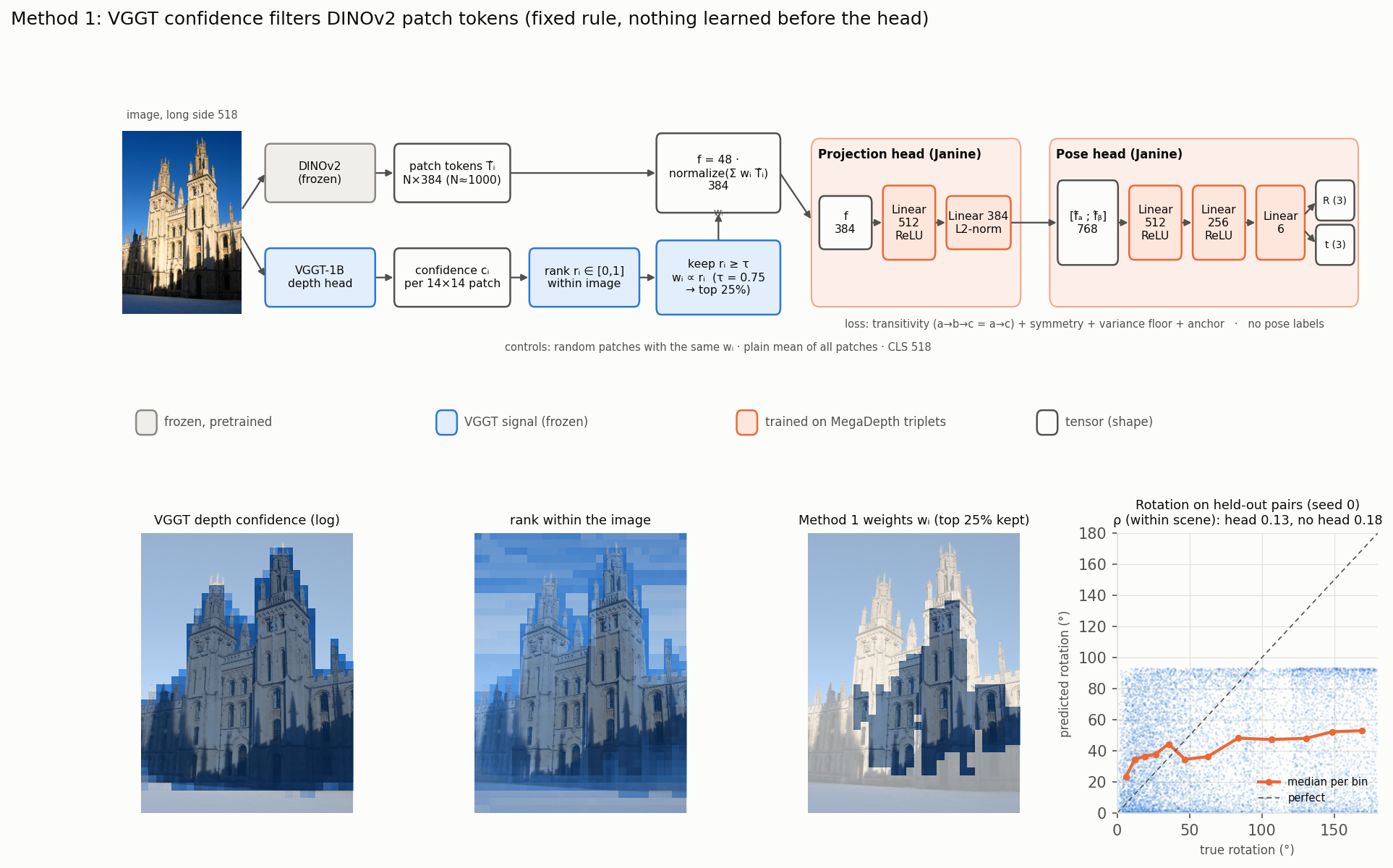
The CLS token summarises the whole image: sky, people, cars. VGGT’s depth head gives a confidence per pixel, . It’s high on facades and low on sky (see my Co-Me notes for the same idea used for token merging). Both models use patches, so after average-pooling the confidence, each DINOv2 patch token gets one confidence .
- Raw confidences aren’t comparable between images, so I use the rank within the image, .
Method 1: fixed filter,
Keep the top of patches by rank, weight them by rank, pool:
is the average length of the reference CLS vectors, so the head sees inputs of the usual size.
Controls: the same weights on random patches; the plain mean of all patches; CLS at 518 px.
Method 2: let a network decide,
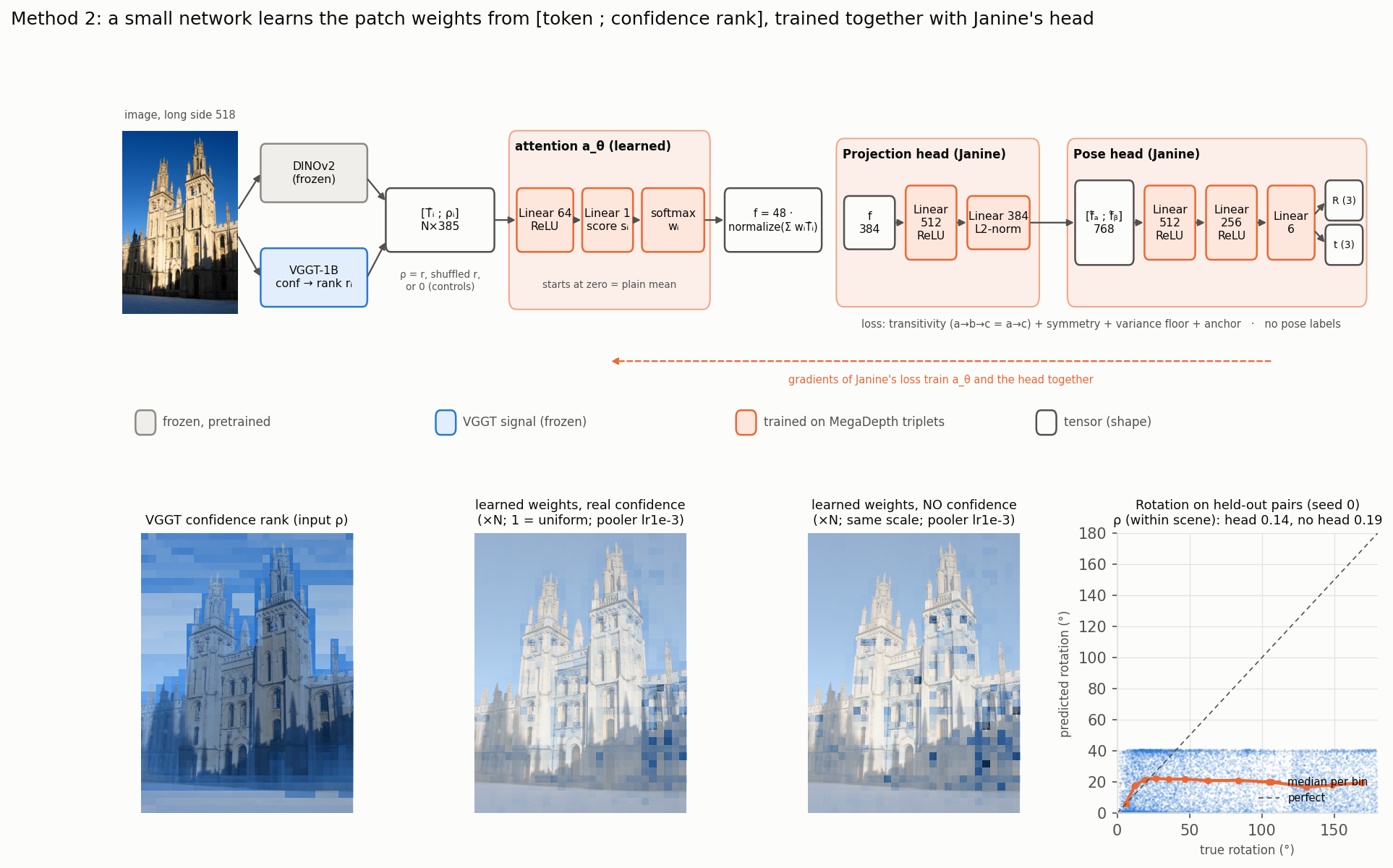
A small MLP scores every patch from its token and its confidence rank. A softmax turns the scores into weights:
- , trained together with the projection and pose heads, using the same loss.
- The last layer starts at zero: at step 0 all weights are equal, i.e. the plain mean. Anything else is learned.
- Three versions of : the real rank, the rank shuffled within the image, or zero. If VGGT helps, real should win.
Why shuffled ranks and not just zero?
Shuffled keeps exactly the same numbers (same distribution, same scale) but breaks the link to where they are in the image. If real ≈ shuffled, the network isn’t using the spatial information, only the extra input. Zero tells what the pooler learns from the tokens alone.
Data and training
- Triplets: the original JSONs weren’t available, so I rebuilt them from the MegaDepth COLMAP poses: rotation 120–179°, the farthest 10% by distance, 2000 triplets per scene, 80/20 split.
- Our statistics for scene 0015 match the thesis’ Table I to every printed digit. So that table describes one scene, and the distance is on COLMAP’s world-to-camera translations, not camera positions.
- 8 scenes, 12,800 training triplets and 3,200 held-out ones with known poses.
- Only the small networks are trained (DINOv2 and VGGT frozen). Adam , batch 512, 100 epochs, 3 seeds per setting. The heads train on CPU in ~4 min; Method 2 needs a GPU because all ~13.5 M patch tokens (10 GB) live in GPU memory.
How I checked "does it learn geometry?"
On held-out pairs, compared with the COLMAP poses (never seen in training):
- Spearman between predicted and true rotation angle: does the head at least order pairs correctly?
- computed within each scene: COLMAP’s scale differs per scene, so a correlation over all scenes also rewards an input that just recognises which scene it is.
- a no-head baseline: the same using only of the inputs. Zero training.
What came out
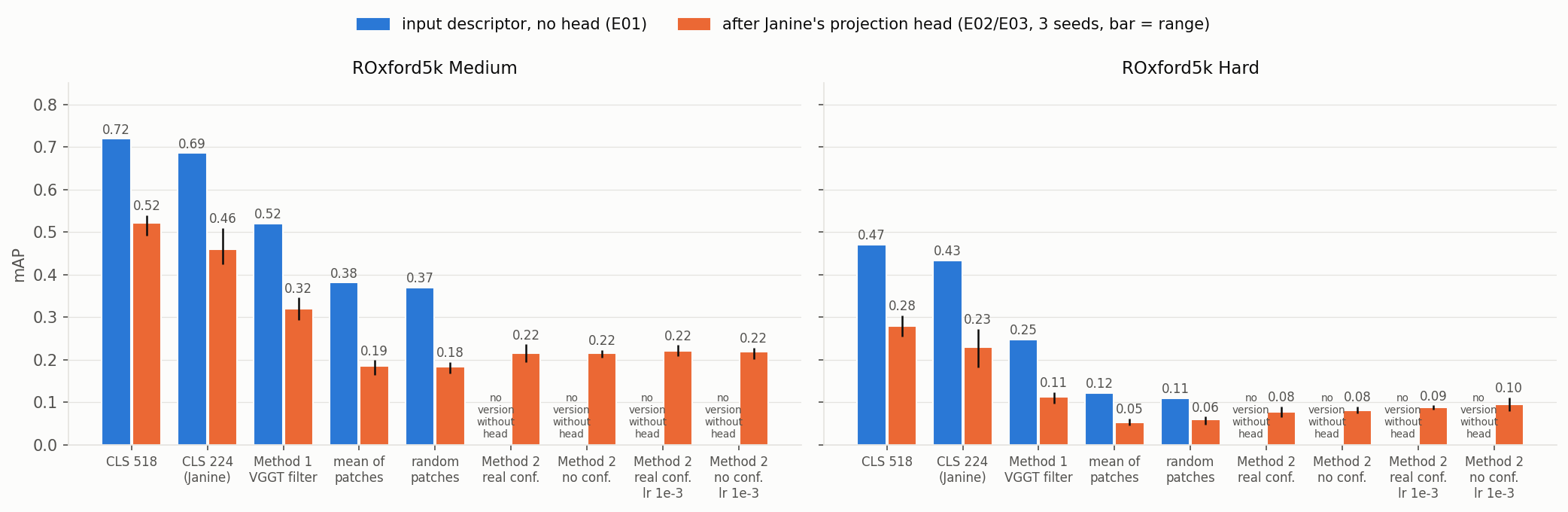
Retrieval without any head (ROxford5k, Hard mAP): CLS 518 0.47, CLS 224 0.43, Method 1 0.25, mean of patches 0.12, random patches 0.11.
- The VGGT filter clearly beats random patches (significant at every ), so the confidence is meaningful.
- But averaging patch tokens is a much weaker descriptor than CLS. It isn’t the normalisation (raw vs normalised differ by ≤ 0.002). DINOv2’s patch tokens are trained for local tasks; CLS is the token trained to summarise.
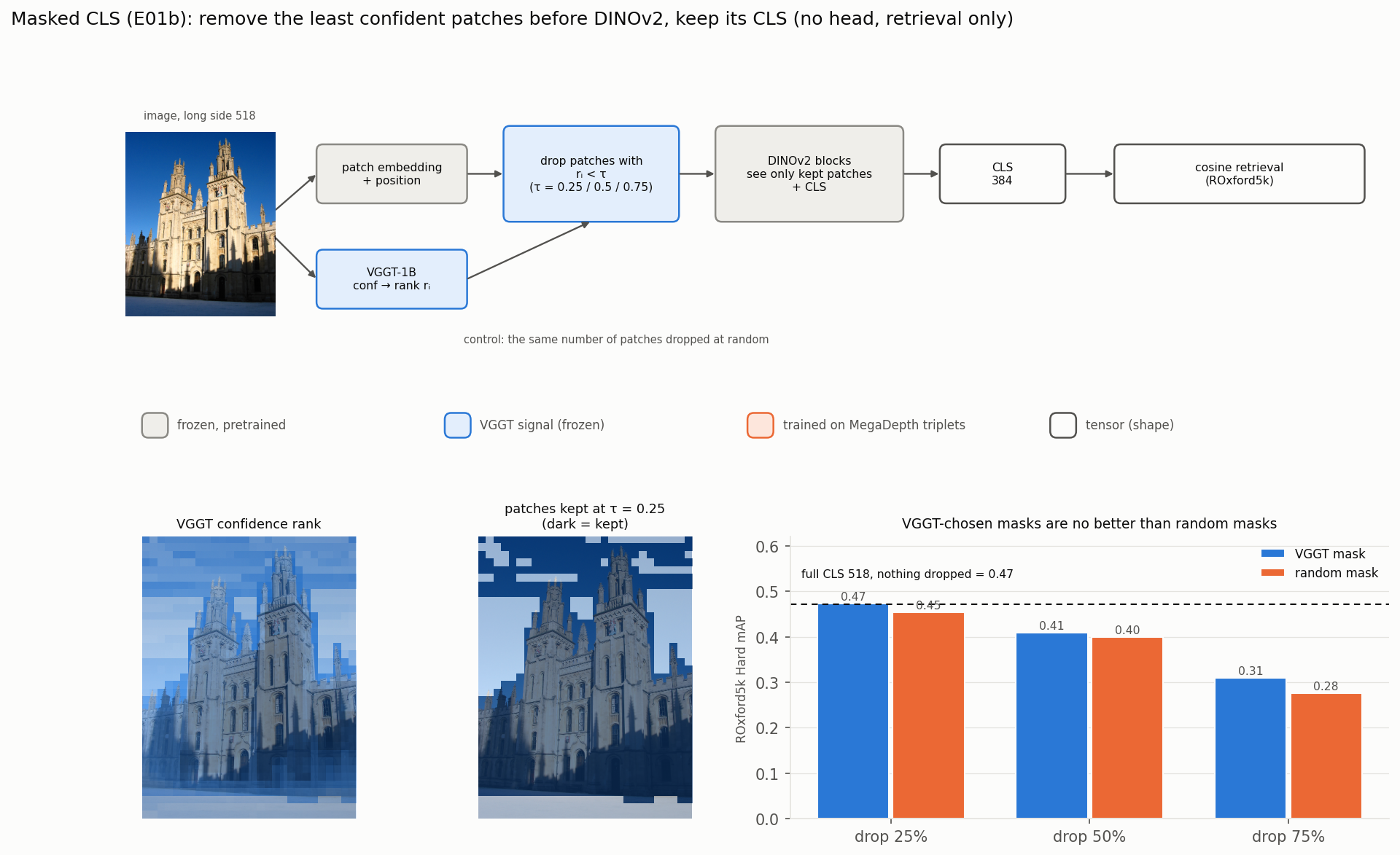
Then what if VGGT only removes patches and CLS still does the summarising?
Tried that: drop the least confident patches before DINOv2’s blocks and keep its CLS. Dropping 25% costs nothing, more hurts, and VGGT-chosen masks are not better than random ones. CLS already ignores the sky by itself.
The head on top (5 inputs × 3 seeds):
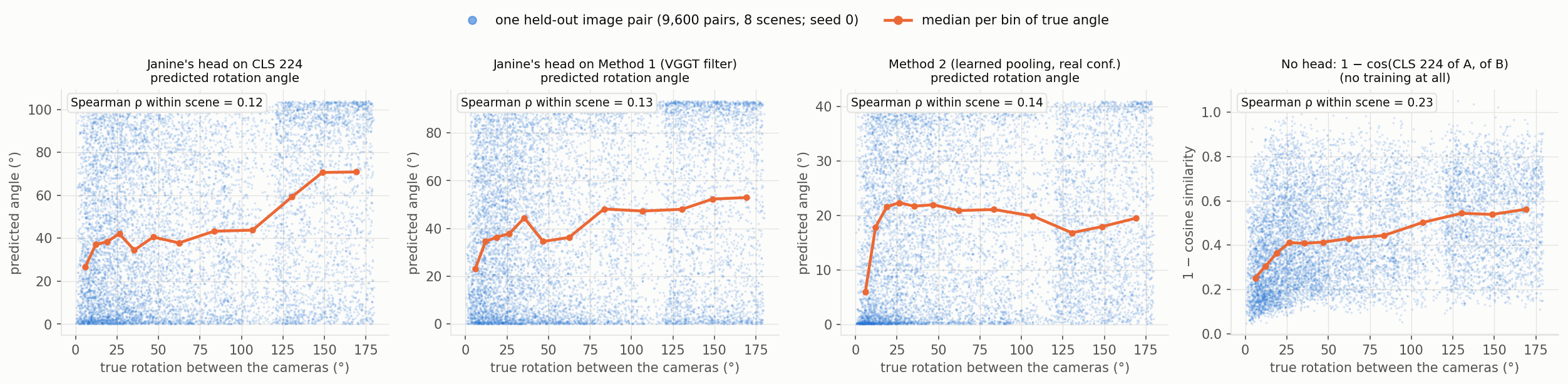
- No rotation is learned beyond similarity. For every input, plain of the inputs orders pairs by true rotation better than the trained head (e.g. 0.23 vs 0.16 for CLS 224).
- Consistent, not correct. The cycle vs closes to ~0.25° on new triplets, yet the angle error is never better than always guessing the median. Each head has a ceiling (≈104°, ≈92°, ≈40°) and a pile of predictions near 0°. It squeezes rotations into a range where they’re easy to keep consistent.
- The head hurts retrieval for every input (CLS 224: 0.43 → 0.23), and the input ranking stays the same.
A trap I almost fell into
With all scenes pooled, Method 1 looked 2.5× better than the mean for rotation (0.15 vs 0.06). Within each scene the difference is zero (0.13 vs 0.13). The descriptor was separating scenes, not judging rotation. Always split by group before trusting a correlation.
Method 2: real ≈ shuffled ≈ zero on geometry, retrieval, and even the training loss.
- At lr the pooler barely moves from the mean. With the pooler at it really moves (it uses ~45% of the patches, cosine with the mean ~0.8), and real vs zero are still the same.
- Both versions end up putting ~40–47% of their weight on the 25% most confident patches. Without being told the confidence, the loss pushes the pooler towards the patches VGGT is confident about. The information is already in DINOv2’s tokens.
Does this mean the reference model looks at the sky?
Partly, yes, and it’s visible here too. With a head trained on the structure-filtered input, the sky becomes the most similar region after projection (last column). The projection doesn’t preserve “where to look”; filtering the input doesn’t fix that.

My thoughts
- Method 1 on this image keeps the shadowed lower facade on the right and drops both towers. That’s exactly the drawback I suspected in the prototype: VGGT is confident about close structure, not about the landmark.
- So is VGGT useless here?
- Not useless, redundant. It beats random selection when patches are averaged, but DINOv2 already encodes the same information: CLS ignores those patches, and a learned pooler finds them on its own.
- Is the problem the input or the objective?
- The objective. If the head can’t beat raw cosine similarity on rotation for any input, no input change can show a benefit. The losses prevent collapse, but nothing points to the correct pose.
- Then where should VGGT go?
- As a teacher, not a filter: pseudo-labels for relative rotation, gated by VGGT’s own confidence (supervised where VGGT is sure, transitivity where it isn’t). MegaDepth even has real poses for a small supervised warm-up.
- Or use its aggregated tokens / pose outputs instead of only the confidence.
Next: discuss with Nicola which of these to focus on. One topic only.
Related