How can we identify and reduce redundant tokens in VGTs without compromising geometric fidelity?
It is an acceleration mechanism for VGTs (e.g. VGGT) without retraining or finetuning the base model. It makes them capable of real-time 3D perception by mitigating the quadratic computational cost of Vision Transformers.
- It ranks tokens by uncertainty
- Selectively merge low-confidence ones
This method is similar to what I want to do since they used a distilled confidence module that predicts per-token confidence to guide processing, and a confidence-guided merging strategy that preserves precision.
To be more precise, I am mostly interested in how they use the predicted per-patch confidence score to generate a merge mask during inference (Sec 3.2)
Confidence-Guided Token Merging
Mask Generation & Token Merging
Let be the predicted per-tken confidence scores ratio. They partition tokens along the spatial order into fixed-size groups of image tokens. For each group, if the average confidence falls below the -th percentile across all groups in the image sequence; it is marked for merging. That way the sky gets aggregated into one big region — it makes total sense.
Formally, for a group of tokens , if the merge flag is true, we replace the group with their average; otherwise, remains unchanged
The results are concatenated into a contiguous tensor:
Token Splitting
If a processed token group was not merged in the previous step, copy it to its original position. Otherwise, replicate the merged token for times and place them at their original index.
Attention Bias Correction
This correction realigns the post-softmax attention weights distribution with the original distribution.
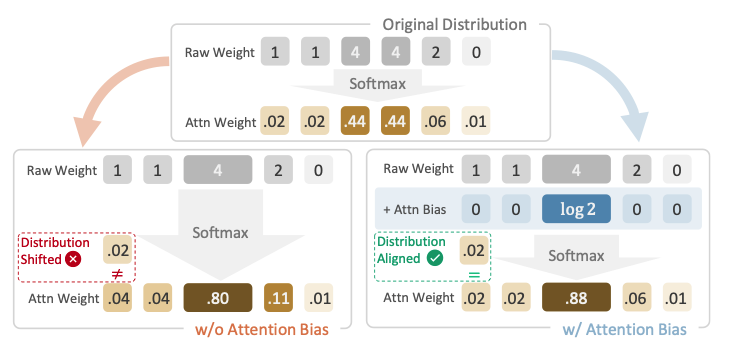
Merging tokens into one concentrates multiple attention weights into a single entry. This causes the softmax operator to suppress that entry's normalized attention weight and distorts the distribution.
attention bias correction compensates by adding a bias term to get the corrected attention logit:
- is the raw attention logit.
Since softmax is exponential, adding to the merged logit scales its weights by and effectively restores the same total mass that individual logits contributed before:
Pose Estimation
Sim(3) Umeyama alignment is applied to remove scale and reference frame ambiguity — this could help with the translations estimates as they would anchor everything into the same frame and therefore, one could trust the results VGGT offers. The rotations do not suffer from this ambiguity.
In VGGT the translations are computed w.r.t the first frame, which is why they don’t generalize to other cases.