This is the PhD thesis of Maciej Stanisław Halber, which is the author of Fine-To-Coarse Global Registration of RGB-D Scans. That paper is from 2017, the thesis was published in 2019.
I only cover the extensions to that paper, not all 105 pages. In the end it should be about 20-25 pages covered.
Context
This approach considers only the problem of reconstructing a 3D model from a sequence of color and depth frames.
The thesis is split in 3 projects
- correcting the depth measurements through an error reduction technique based on estimating an image-space undistortion field. It eventually improves the reconstruction quality.
- adressing the problem of registering RGBD frames over a long video sequence into a globally consistent 3D model. This is basically his work in Fine-To-Coarse Global Registration of RGB-D Scans.
- they show how repeated scans of the same space can be used to establish associations between the different observations. Specifically, a situation where 3D scans are acquired repeatedly at sparse time intervals. This builds a temporal model of a scene with semantic instance information. I guess this could help with moving objects — not my topic of research right now.
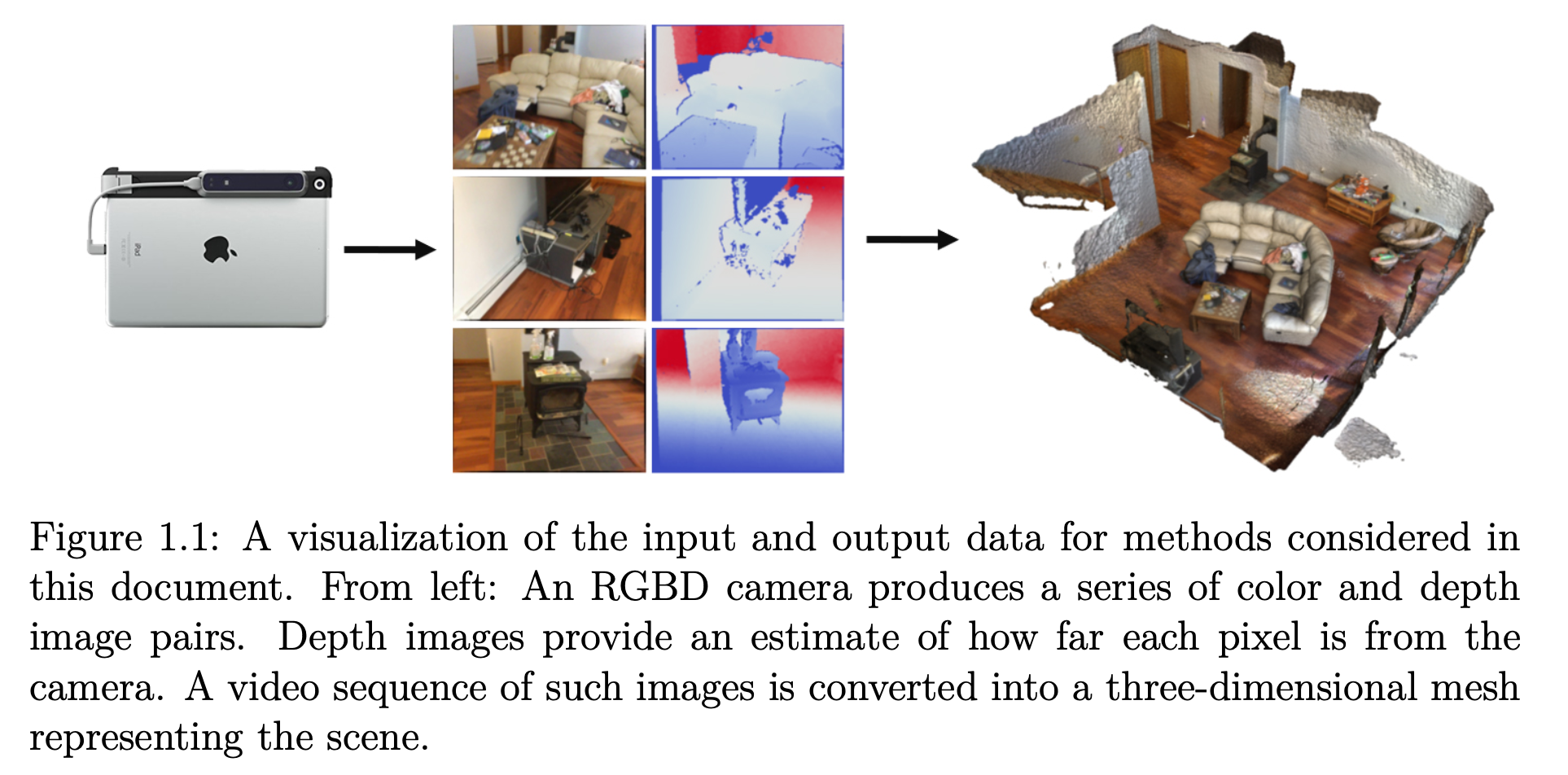
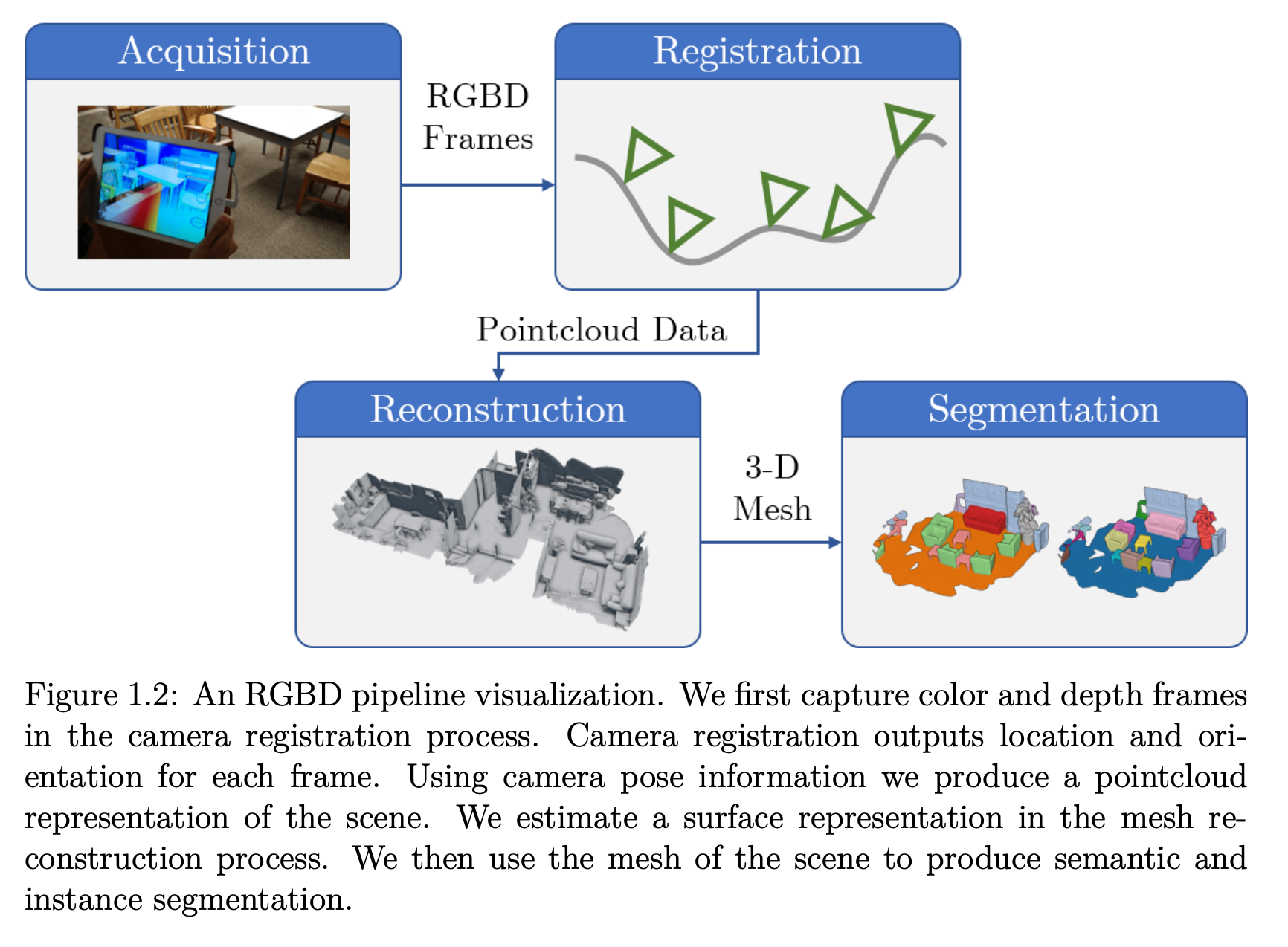
I will be focusing on 1. He presents a calibration procedure that increases the effective range of depth. Calibration data can be obtained in minutes and does not require costly setup.
Does it make sense to cover this since the study mentions it focuses only on PrimeSense-class devices such as Microsoft Kinect, Asus Xtion Pro, and Occipital Structure Sensor?
Apparently no, drop it.