ML Paradigms
- Supervised Learning — Learning from labeled data e.g. “deer”, “dog”,
- Classification, Regression (“what’s the hair density of this deer in hairs per sqm?”), Object Detection, Semantic Segmentation, 3D Reconstruction, SLAM
- Evaluation metrics include: overall accuracy, precision-recall, IOU, RMSE
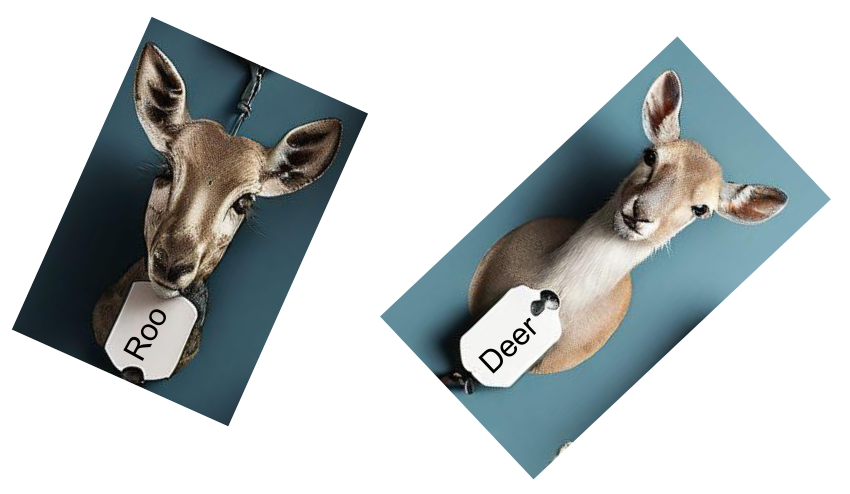
- Unsupervised Learning — Learning patterns and structures from examples in the abscence of explicit supervision.
- Data representation, Clustering, Dimensionality Reduction, Anomaly Detection
- Evaluation metrics include: Silhouette score, Davies-Bouldin index, Reconstruction error, Anomaly score (e.g. distance from a centroid)

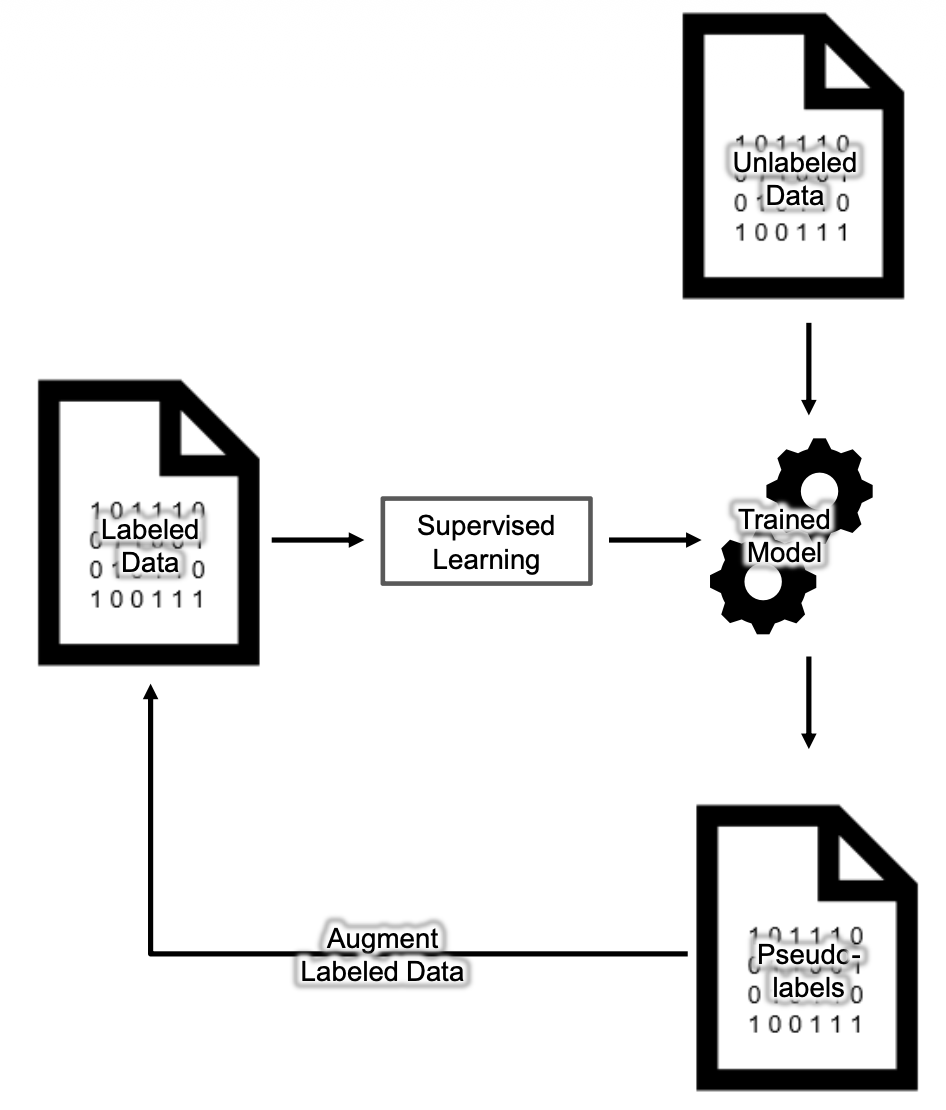
- Semi-supervised Learning — harness both labeled and unlabeled data
- Challenges: cost and time requirements, labeling bias, scarcity of labels, dynamic nature of the data
- Network intrusion detection, Medical image segmentation
- Techniques: Pseudo-labeling, Consistency regularization, Self-training vs co-training
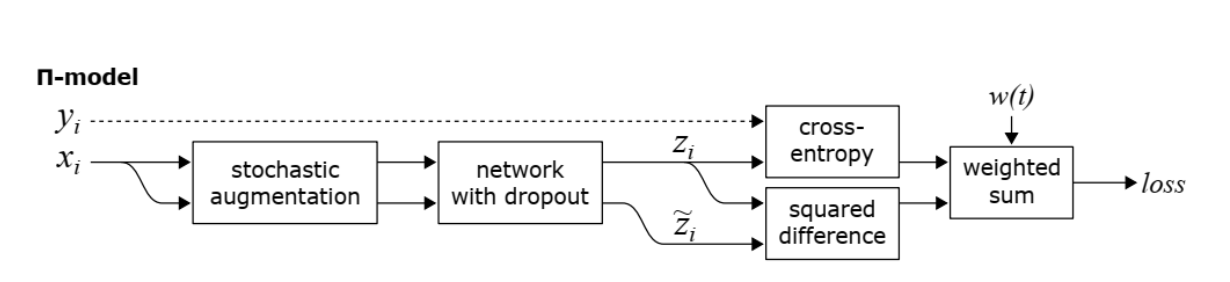
- Self-supervised Learning — generate supervisory signals from input data and designing pretext tasks.
- Spatial or temporal relationships, data transformations (i.e. generative modeling, image colorization), Depth estimation from stereo images
- Techniques: Generative (Autoencoders), Contrastive (CLIP), Adversarial (GANs)
- Techniques:
- Value-based (learn values)
- Implicit policy (e.g. greedy),
- Policy-based (no values)
- Learn policy
- Actor Critic
- learn values, learn policy

- Reinforcement Learning — The main difference to the other methods is that this technique is rather active than passive, and the interactions are often sequential.
- Learning is goal-oriented with possibility to learn without examples of optimal behavior.
- Optimization of some reward signal, feedback is evaluative which represents goodness/preference rather than corectness.
Machine learning paradigms govern how learning algorithms learn from data and make predictions or decisions
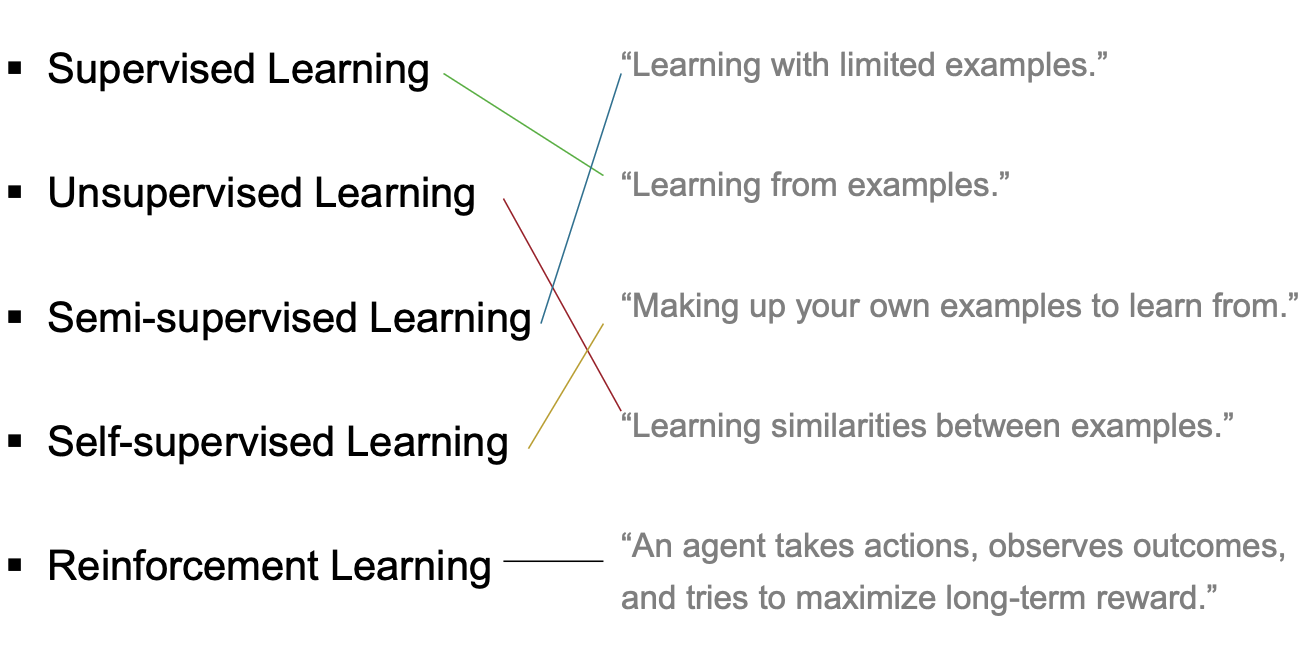
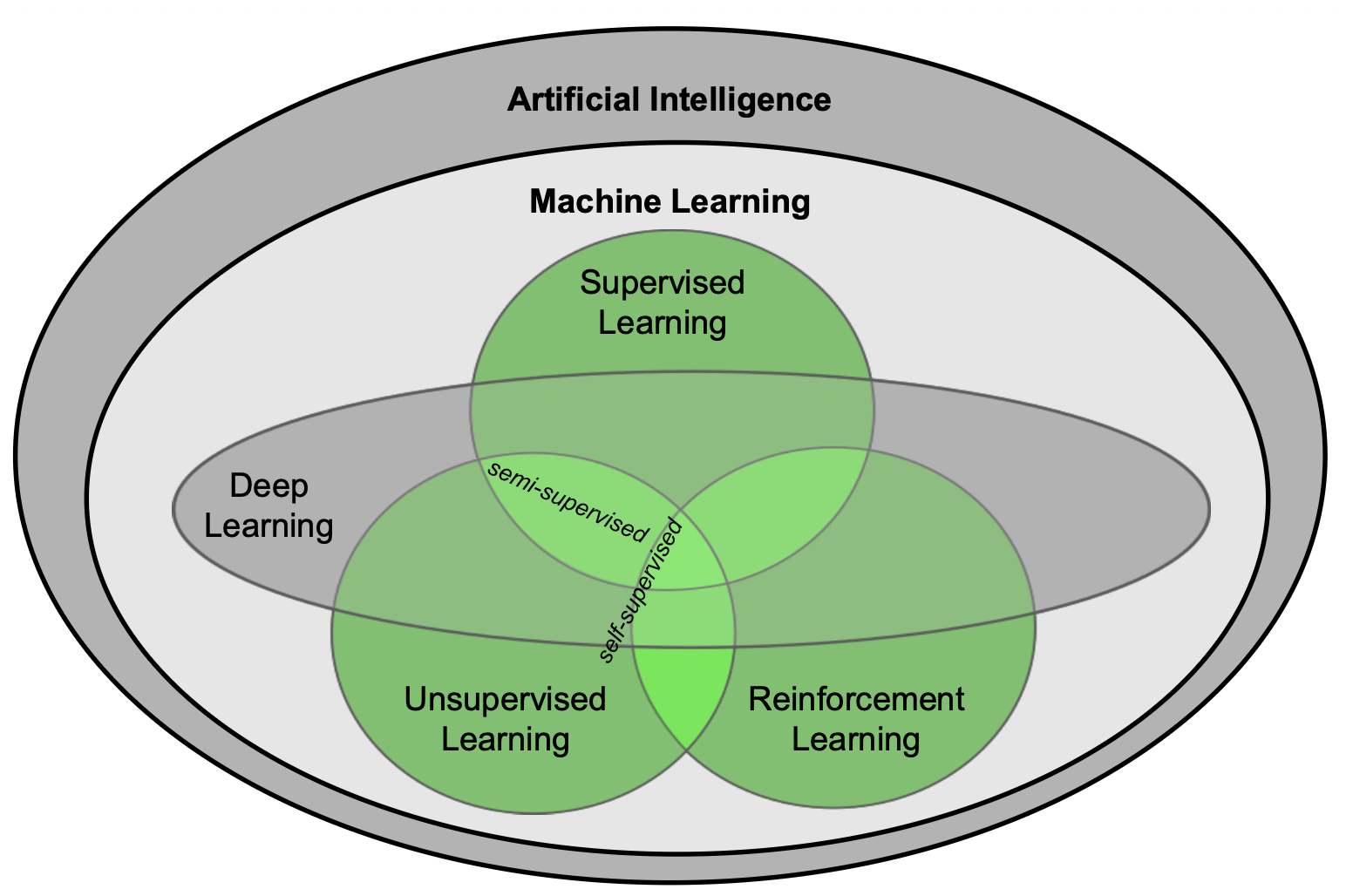
Self-supervised learning is at the intersection of all three circles — Supervised, Unsupervised, Reinforcement Learning.
- It borrows the label structure from supervised learning (but generates its own labels from the data)
- It learns representations without human labels like unsupervised learning
- It uses feedback signals to guide learning, similar to reinforcement learning (idk about this one)
What is the difference between validation and test sets?
The validation set is used to tune model parameters and prevent overfitting during the development phase, while the test set acts as an unbiased, final evaluation to measure how well your finalized model will perform on completely unseen data.