source It’s been around since 2024.
Wouter from 3DUniversum told me most foundation models use this to predict depth. I knew about MiDaS already.
Depth Anything is the most capable Monocular Depth Estimation (MDE) foundation model. It’s better than MiDaS v3.1.
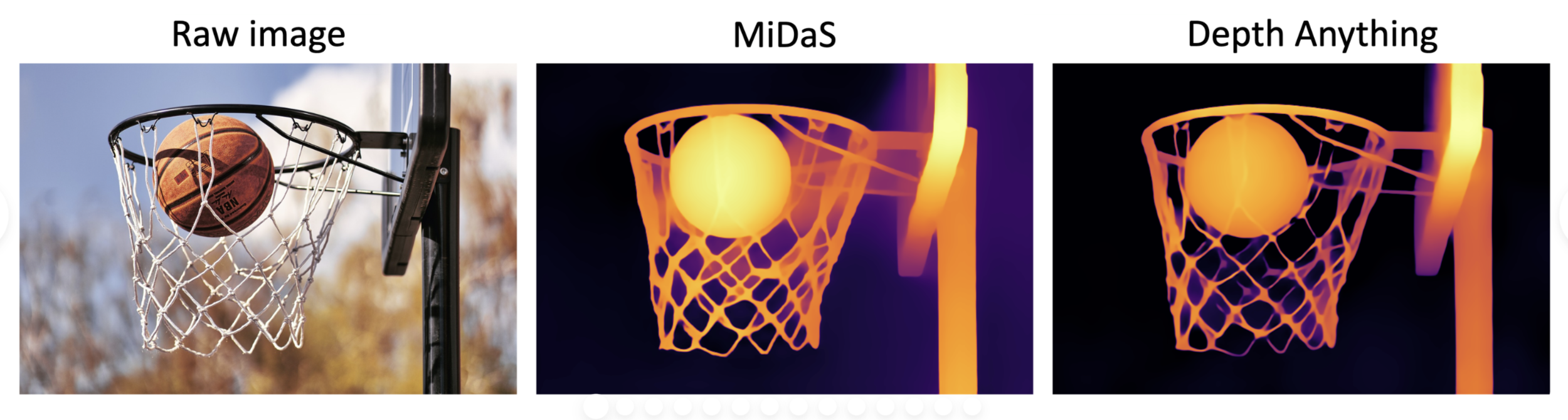
Look into ControlNet
Traditionally, depth datasets are created mainly by acquiring depth data from sensors, stereo matching, or SfM. Which is costly. So they pay attention to large-scale unlabeled data — since monocular pictures are everywhere on the internet.
We can simply use a pre-trained MDE model to assign depth labels for unlabeled images, which only takes a feedforward step
So they bypass the depth maps produced by LiDARs, and the computationally intensive stereo matching process. clever.
In their preliminary attempts, directly combining labeled and pseudo labeled images failed to improve the baseline of solely using labeled images. To address this, they employed a student model with a more difficult optimization target when learning the pseudo labels. The student model is enforced to seek extra visual knowledge and learn robust representations.
They maintain the rich semantic priors from DINOv2 with a simple feature alignment loss. It enhances the MDE performance and also yields a multi-task encoder for perception tasks. To be more specific, it’s the encoder they initialize with DINO’s pre-trained weights.
Architecture
A teacher model learns the labeled dataset and then utilize it to assign pseudo depth labels for . Finally, they train a student model on the combination of the two sets.
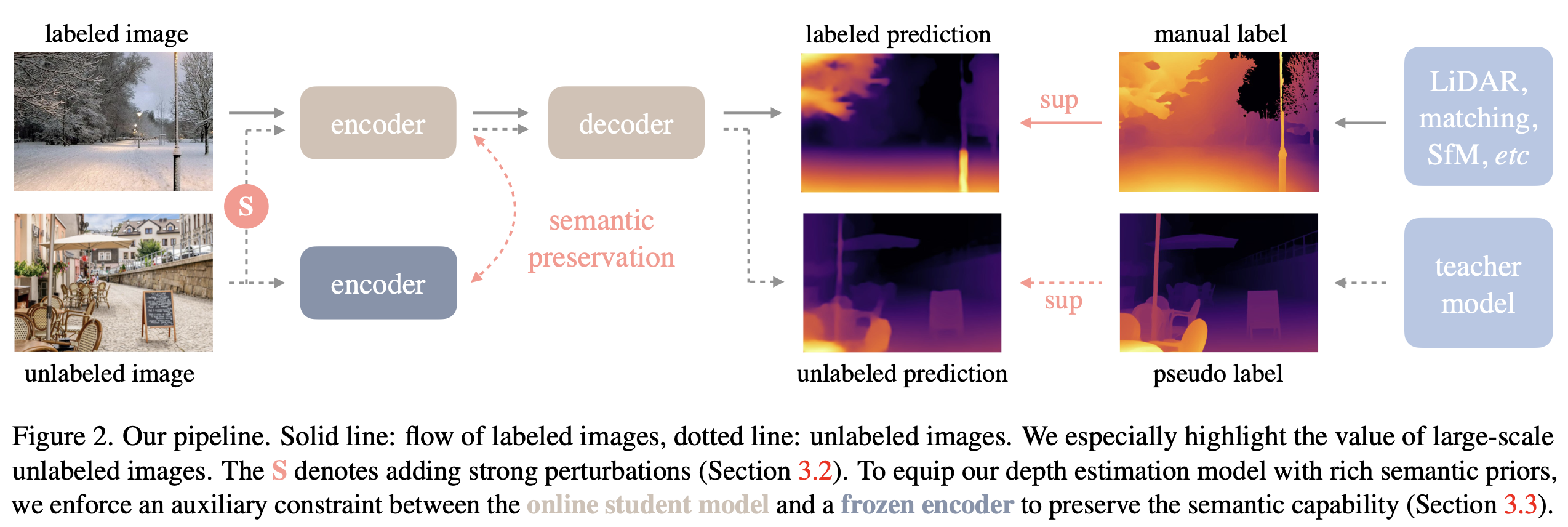
Interesting, in practice they detect the sky region, and set its disparity to 0. Quite similar to what I’m doing with Nicola, but trusting VGGT’s depth head’s attention to fall onto structure instead of structureless regions such as the sky.
The perturbations they include are:
- strong color distortion i.e. color jittering, Gaussian blurring
- strong spatial distortion through CutMix.
“Despite the simplicity, the two modifications make our large-scale unlabeled images significantly improve the baseline of labeled images”
Another interesting thing, they employ a invariance idea. Basically, the depth of a region shouldn’t depend on what’s pasted next to it. The model is forced to produce the same prediction for a patch whether it appears in its original image or spliced next to a totally different image.
- “even though I’ve corrupted your usual contextual cues by gluing two scenes together, you must still produce per-region depth as if each region were seen in isolation (matching what the teacher saw on the clean original)”
The feature alignment loss is basically a cosine distance between two feature vectors.
- frozen DINOv2 encoder
f' - student encoder
f - minimize , averaged over spatial positions
One detail worth knowing: they don’t force exact alignment. They use a tolerance margin , so pixels where cosine similarity already exceeds are excluded from the loss. The reasoning: DINOv2 features carry semantic info that isn’t all relevant to depth, so forcing perfect alignment everywhere could hurt depth-specific learning — they just want to keep the student “close enough” to retain useful semantic priors, not clone the teacher’s features exactly.