Related to MLP and Machine Learning.
Dropout is a regularization technique that randomly zeroes activations during training so no single neuron can be relied on.
It prevents overfitting.
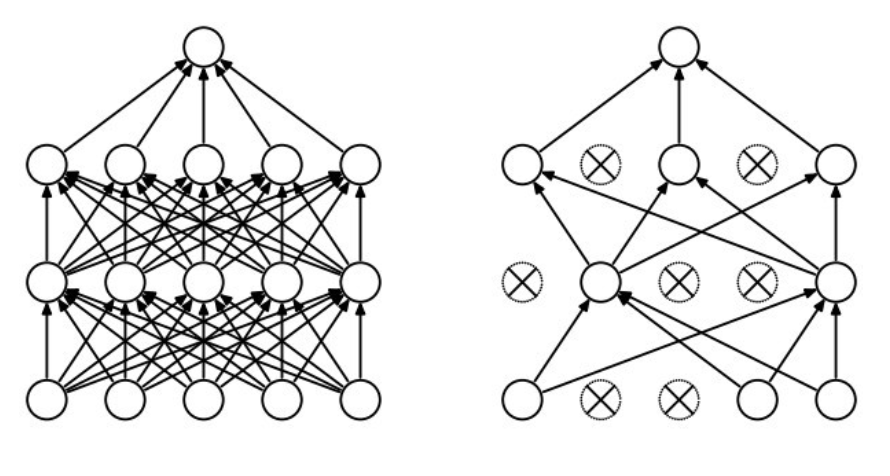
Why would randomly deactivating the network help?
Because it forces redundant representations and prevents co-adaptation (neuron A can’t rely on neuron B always being on).
- When an activation is dropped, its output thus its gradient in backprop are both 0.
You can’t rely on any specific teammate showing up, so every neuron has to be individually useful. No “this feature works only if that other feature co-activates” hacks, because at any given step the other feature might be dropped. It’s ensemble learning disguised as a regularizer: you train an exponential number of subnetworks with shared weights, and at test time you implicitly average them by scaling.
- Train: at each forward pass, sample a random binary mask and zero out activations with probability , common setting
- Test: don’t drop, instead scale all activations by so the expected output matches training
Intuition
At train time, each neuron fires with probability , so its downstream expected contribution is . At test time nothing drops, so activations are larger on average by a factor of . Scaling by at test time (or equivalently at train time, “inverted dropout”) lines the two up so the network sees the same expected input distribution in both phases.